

THE REAL THING
On slowing time, unmasking artists, and finding the true story inside a novel.

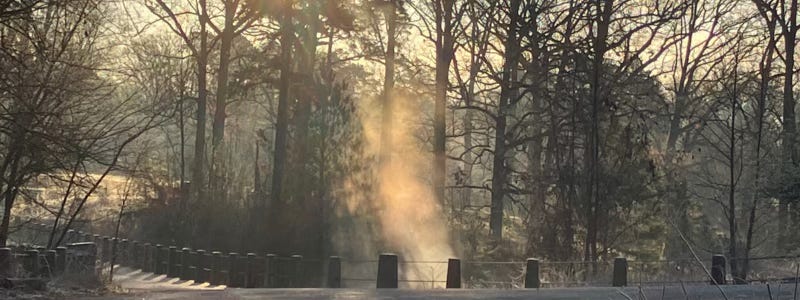
“And they all pretend they're orphans, and their memory's like a train / You can see it getting smaller as it pulls away / And the things you can't remember tell the things you can't forget”
(Tom Waits, “Time”)

THE INTERRUPTIONS THAT SLOW TIME
Three birthday surprises and a list for the next 22 weeks of living
My birthday this past week was almost as uneventful as I pretended I wanted it to be. My plan was simple: wake, walk the dog, facilitate a client session, come home, write.
I’ve resisted birthday celebrations for as long as I can remember. As I’ve grown older, I’ve learned to appreciate two important facts about my resistance. It can be unfair to people who care about me. And the adult version of the socially awkward kid who grew up in a broken home and learned at an early age to not need anything comes by it honestly.
This year, my plan almost worked. But three small things interrupted my intended rhythm.
A surprise morning encounter with a friend at Bryan Park turned into an impulsive hug — natural for her to give, unexpected for me to receive. I blushed, embarrassed that someone was celebrating me.
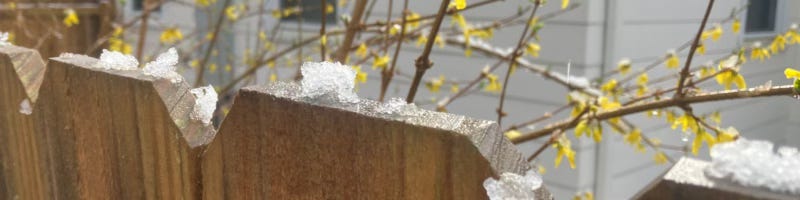
That afternoon, I walked out of my work engagement into a lovely cascade of snow, a birthday first. It was light, fluffy, wet. The snow covered my hair and sweater, and for a few minutes the late winter grass went white. Like a solar eclipse, a derecho, a sunset: it arrived suddenly, left an impression and vanished.
The evening brought my children, bearing flowers, coffee and spoons. (Thanks to a mobile teen who eats breakfast on the run, the spoon turnover/loss rate in my house is high.) They dragged my reluctant and grumpy ass out into the cold evening for ice cream. And it was perfect.
Three interruptions. None of them planned. All of them, briefly, slowing time.
That is something I’ve been thinking about a lot lately/again — how we experience time, why it seems to move faster as we get older, and what, if anything, we can do about it. I have a mom who is losing memory and time; a teen who is accelerating into her life; and a tween who still wonders if “we’re almost there yet” on a regular basis.
And me. Spending long moments every week trying to be present across everyone else’s calendar.
Several years ago, I encountered former speed skater John Coyle at an event we both spoke at in Chesterfield. I was taken by his thoughts on time.
“Remember when summers used to last forever?” That’s how Coyle started his talk, going on to explore the idea of creating “endless summers” by hunting down new experiences and “firsts.” Imprinting the brain with new and unexpected memories, he suggests, can make a moment feel like an hour, a single weekend feel like a month.
Coyle in a nutshell: Kill your routine before it kills your memories.
Another way of thinking about it is that we slow time when we make life matter more than measurement.
I spent part of my post-birthday weekend making lists, which was not me creating a punch list of assignments but rather me organizing my thoughts. Around who matters, what’s interesting, and how I want to spend the balance of this year.
Time organizes our lives whether we want it to or not: Eleven more weeks with the kids before one heads to college, another to middle school. Eleven weeks of less structured time interlaced in the same window. A busy consulting practice layering the entire calendar.
How do I want to create more surprise — more life — just in the next 22 weeks?
I started with who. Family, friends, people I keep bumping into around town, mentors and community voices who resonate with me. Who are the people who resonate with me from places of care, connection and curiosity? Who knew the version of me before I got married? Who is waiting for me to call who won’t call first? It’s a long list. It’s sort of beautiful to review.
The other two lists are essentially intentions, experiences, and places. One very interior, and centered around nurturing my introverted energy with writing and learning, quiet relationships, nature, healing, tending. Sit by a moving body of water for an hour without a pen or phone. Write my actual consulting philosophy in 500 words, but just for me. Have a quiet conversation, where I just listen, with someone I love about fear.
The second is exterior, and more active. Oriented around places and events — with people I enjoy. Go with friends to a dinner and concert. Explore new parks and landscapes. Organize a random group to meet up on the York River for a hike, or at a vineyard for lunch, or a museum for an art immersion. Weaving more relational experiences around music and nature and friendship into these coming weeks.
The real work is not making lists. It’s turning lists into life. That involves extending invitations — to myself, and to others. Who wants to join me? Who will reach out first? Who am I not thinking of?
It started with a birthday, and then an intention, and then a list, and then this essay. It continues this week with a dinner conversation with the kids about spring break and summer. And with this: who wants to meet up in Charlottesville for the Tom Tom Festival? Catch dinner before the Old 97s? Take in the French Italian Film Festival? Hunt for fossils and memory on the York River, then grab barbecue?
Life is not a measurement. Lost spoons can be replaced on holidays. Lost time? That just becomes regret.
IGNORE THE ARTIST, EXAMINE THE ART
Banksy, anonymity, and why art sometimes needs a mask
I was recently prompted by an image sold as a Banksy print to do the unthinkable — research. Along the way, I discovered that “Colored Rain,” which depicts a man with an umbrella sheltered by colored rain while a small child dances unprotected nearby, is not a Banksy print at all.
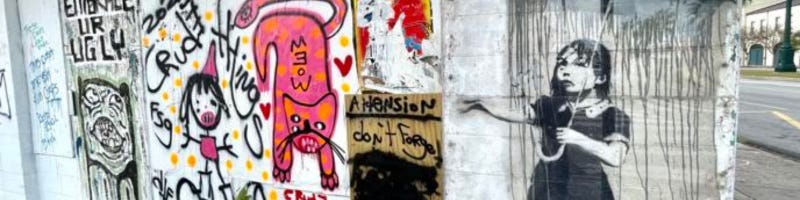
I had been drawn to it as a direct contrast to a piece that is verified Banksy, a black-and-white stencil in New Orleans. One of 14 pieces he created in 2008 speaking to the city’s 2005 catastrophic flood from Hurricane Katrina. In “Nola” rain pours down from within a young girl’s umbrella, while her outstretched hand stays dry. A quiet, precise indictment of the government’s inability to protect and care for its most vulnerable.
For almost 30 years, the guerilla art of Banksy has worked on that same register. Anonymous, unexpected, political. Simple stenciled imagery — easy to throw up quickly on a cinderblock wall or downtown underpass — anchored around universal themes. And children often bearing witness.
The fake “Colored Rain” raises the questions Banksy’s work has always provoked. They’re also questions that feel urgent in our era of deep fakes and AI produced creative art.
What makes a Banksy a Banksy? In some ways, it is the dodgy intersection of authenticity and anonymity.
Does it matter then that “Colored Rain” may have been created by Mr. Brainwash, himself a manufactured artist with his own complicated relationship to Banksy’s world? Or that “Colored Rain” is essentially what you’d get if you asked AI to create a cheerful piece of anti-Banksy art? And yet it sold as the real thing.
Does it matter if Banksy is French or British? One artists, two, or a collective?
What we are really buying is the veil: the prism that lets us look around the artist and see only the art.
What we are really buying is the veil: the prism that lets us look around the artist and see only the art.
Reuters just pulled back the veil. Their investigation into the identity of the world’s most famous urban artist may have changed the work itself.
The Reuters story starts with an argument: that the anonymity of an artist whose work “serves vital societal interests” is less important than public interest, transparency, and even accountability.
In a 2010 interview, the artist himself made his own argument for staying private: “I don’t know why people are so keen to put the details of their private life in public; they forget that invisibility is a superpower.”
But Reuters decided “public interest” decreed an investigation. They proceed to the line-up of potential Bankys but push hard and early on the possibility of Del Naja being Banksy before pivoting.
Identity aside, the Reuters piece offers a fascinating reconstruction of Banksy, and of modern graffiti and stencil art. In past interviews, Banksy admits he found early inspiration in the anarchist art of British punk band Crass and their anti-authoritarian, pro-pacifism, feminism and environmentalism stances.
Reuters also explores the idea of appropriation and originality. Another old interview: Banksy points to French street artist Blek le Rat. The back-and-forth that ensued lays out the tension between creation and inspiration. “Every time I think I’ve painted something slightly original, I find out that Blek le Rat has done it, too,” Banksy said. That same year, Blek responded, “I’m the old man, he’s the new kid, and if I’m an inspiration to an artist that good, I love it.”
Later, Banksy points to another inspiration — Del Naja, aka Massive Attack’s 3D.
And just when you think Reuters is about to yank the mask off the real Banksy, they pivot to another Bristol native, Robin Gunningham. And that’s where Reuters finally lands, but without confirmation. Which suits me just fine. I happen to agree with Banksy.
“Nobody ever listened to me until they didn’t know who I was.”
SHUT UP & WRITE (FOR REAL)
How an editor helped me find the real story inside my novel
It’s good that Heather’s 50-page editorial letter arrived two weeks before we got on a two-hour Zoom to unpack Revolution Summer. The call happened this past Monday, and I needed that breathing space. I needed to unhook my ego, and invest energy in some hard questions she was encouraging me to answer, before our call.
The resistance came first, as it usually does for me. Eleven points of view are too many, she’d written. Readers can’t stay invested if they keep getting pulled out of one emotional current and dropped into another. And — the hardest question — who is the protagonist?
My internal response was approximately: everyone is the protagonist, Heather. That’s the whole point.
But I sat with it. I went back to her questions. I resisted those too. Then I went back again. And I wrote, and journaled, and processed.
Of course, music is what cracked it open. In writing the novel, I’d laid down eleven tracks simultaneously — Brendan’s arc, Katie’s arc, their friends, the coach, the parents, all of it — and insisting they all deserved equal volume. Their stories mattered.
What I finally heard, sitting with Heather’s letter on a sunny March afternoon, was that I’d buried the two tracks that actually matter. Turn everything else down. Let Kira and Leah come forward. Let it be their story, fully.
The second realization arrived quieter. Revolution Summer is not primarily a love story. It is a story about two young women traveling parallel roads toward the same destination from opposite directions. Kira moves fast — velocity is her defense, her identity, her way of not being caught. Leah has gone still — childhood trauma packed away, waiting for someone to give her permission to take up space. Love is not the story. Love is where they finally intersect. It is the missing ingredient that catalyzes what they’ve each been resisting.
And that makes Kira the protagonist. Not because Leah matters less — she doesn’t — but because this is a story about what happens when someone who has never stopped moving finally does. Leah is the reason she stops. And when she begins to stop, Leah is able to move. That’s the novel.
I got on the Zoom call expecting to defend some of this. Instead, Heather had already seen it. The two hours were less negotiation than excavation — both of us digging toward the same thing from different ends of the tunnel.
I left the call with a revised framework: two POVs, one clear protagonist, two girls with distinct and intersecting arcs, and a commitment to profluence — keeping readers engaged with a story that moves forward on its own earned momentum.
Since then, my brain has mostly shut up. And I’ve been writing.
I’m nearly through a second revision that feels, for the first time, like the actual novel — not the scaffolding around it. Leah is claiming her space. Kira is learning to stay still long enough to be loved. And their love feels more real, more earned. More honest.
Which is the story I want to finish writing.
I found this post because of Banksy, but the opening segment on slowing time was what I most needed. Thank you.