


“You and I have memories / Longer than the road that stretches out ahead”
(The Beatles, “Two of Us”)

PRAYER OF PANCREATIC CANCER
Our lives are built with unintentional moments of clarity. In my experience — perhaps because I am sometimes a shallow listener too consumed with my own thoughts — the moments that force the most clarity tend to be unruly, unanticipated and emotionally destabilizing.
Which may explain why I sometimes seek out the discomfort, the frayed threads.
One frayed thread that has consumed a slice of my attention since December is former Senator Ben Sasse’s journey of mortality. Sasse is a near peer — in age, in temperament. Daughters near grown, a young teenage son. Expansive, thoughtful and idealistic in his politics. I’ve admired him for years.
In October, his back aches began. In December, his diagnosis arrived.
Pancreatic cancer. Lung cancer. Liver, vascular, lymphoma. His entire body under siege.
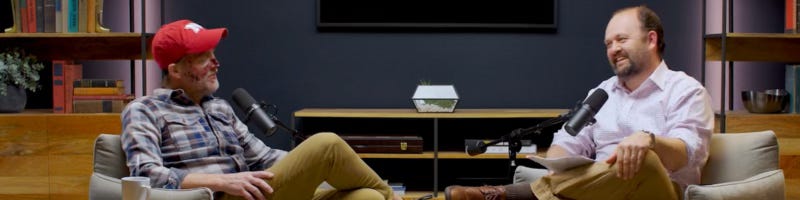
Doctors gave Sasse three months to live. I just watched a long interview with him on the “Interesting Times” podcast on the New York Times; he was 100 days into his journey. Face bloodied (his treatment keeps his body from creating new skin), spirits high, diagnosis still grim.
Sasse reflects that “we’re all on the clock, and I wanted to have prioritized better.” And, “I know going through the period of suffering that I’m going through is a benefit because it is a winnowing.”
A winnowing is the process of blowing air through grain to remove the chaff.
I’ve felt such winds in my life. The precarious births of both children. My own cancer diagnosis in 2019. The collapse of a 20+ year marriage. My mother’s sudden death. Unexpected gusts. A reckoning. Then, clarity.
But I don’t think Sasse’s reflections are just the observations of a dying man. They’re words, feelings — a sense of things — that we all carry, that we suppress until we can’t.
Sasse uses the word finitude to name the way a confrontation with the finiteness of life can be a clarifying force. Clarifying what actually matters.
For many of us, most of the time, we wander through our lives in a comfortable fog about what matters. Until something breaks: a marriage, or terminal diagnosis, a birth or a death.
We often frame these as difficult events to move through quickly, to avoid the liminal space — that unstructured pause between this and that, between awareness and action. A place of prayer, reflection, penitence.
Sitting with difficulty can be uncomfortable. Sasse gives thanks for the hard pause, the opportunity to sit with the finiteness. Of everything.
“I hate pancreatic cancer,” he says on the podcast. “I would never wish it on anyone, but I would never want to go back to a time in my life where I didn’t know the prayer of pancreatic cancer.”
The prayer of pancreatic cancer. The prayer of a difficult birth. The prayer of a marriage broken. The prayer of losing the person who knew you longest.
That’s the winnowing. The long moments of clarifying prayer.
What does it take for us to actually see our life, as it is, while we’re still in it?
Sasse can see his life clearly because of the tandem pull of his temperament and his deep religious faith.
But the cost of paying attention? Seeing Sasse’s bloodied face during the podcast is a reminder that there is a cost to clarity. We accumulate experiences and scars. The evidence of a life being lived. Sifting through the evidence for awareness becomes the future work. The work helps us recognize the prayer, and to know that when the skin thins, and the fog lifts, we may not be losing, or dying, but finally, for the first time, seeing.
DOING THE MATH FOR MOM
I’m writing this between memorials — my mom’s on Friday and an old friend’s on Saturday. At home with the dog, quiet. Thinking backwards. Counting.
Sitting in the front row of the chapel at Westminster Canterbury during my mom’s eulogy was an exercise in emotional tunnel vision. One sister was to my left. My daughter to my right. Both crying. Jack sat beside Thea, his face shifting through an array of emotions.
I smiled at his voice rising in hymn, singing “All Creatures Great and Small” for the first time in his life. And then he stood and walked to the lectern and read the poem my mom made us read together every Easter when she filled her house with extended family.
His voice was strong. A reminder that the poem was finding new meaning in a younger, steadier set of lungs.
Math was a thing my mom was worst at. That, and self-confidence in social settings. Which maybe is why I was feeling anxious about the reception. And counting.
Her three children. Seven grandchildren. Two great-grandchildren. Her brothers, two nieces and a nephew. Their children. First through fourth cousins. Some 3,000 years of lived experience gathered in one place to celebrate her life.
Two cousins — both pushing 80 — drove from Cincinnati. An elementary school classmate drove seven hours. A granddaughter with her two great-grandchildren came in from Indiana.
Several dozen current and former staff filled in the back of the chapel. Old coworkers, friends, current employees she helped hire three decades ago.
Her fingerprints are all over that building. She built the recreation department at Westminster Canterbury from a small art room with a single employee to a performing arts theater, woodworking shop, dance studios. A staff of a dozen or more — the creative spine for a community of a thousand people. Thirty years. She retired, and left. Then came back for four more as a resident herself.
I sat and inventoried 86 years of life, imperfectly. She left the world a richer, fuller, better place than she found it. She just never fully believed it.
That was the math she could never quite grasp: the cumulative gravity of her own orbit. She spent so much time worrying she was a burden or a blur, yet there I was, calculating through tears the lives she shaped just by existing.
I felt those years of lived experience behind me. The ripples. Eleven days after her death, and her impacts are still radiating — the story of the Chrismon Tree she created with residents in 1977; the resident taking her first clay class; Jack’s voice rising through the chapel like a bell.
BEFORE WE KNEW THE LYRICS
Music has always been a throughline in my life. Certain bands — 7 Seconds, U2, Echo & the Bunnymen, Pavement, Middle Kids — anchor chapters of my story that hold a tonal resonance, lyrics that reflect something of who, or where, I was in a moment.
The best of these moments hold a tension between joy and grief, or loss and resistance.
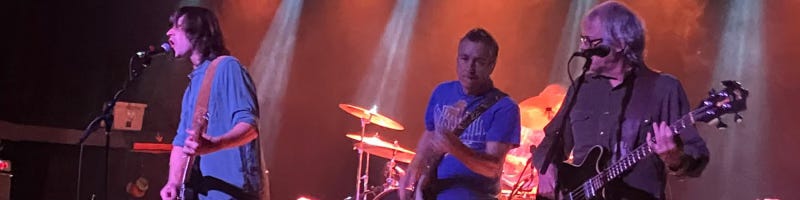
Last week, one of my touchstone bands passed through town. I saw them raise the roof at the Broadberry with a relational anchor, a friend of 42 years.
Long ago, a different friend gave me a CD for my birthday. The Old 97s, Satellite Rides. A few weeks later, I was visiting Angie (then just a friend of 17, not 42, years) in San Francisco. She was excited to introduce me to a band she loved. They were in town. A small basement club with a few dozen diehard fans.
I already knew the songs, which made the night even better.
Fast forward to last week. Angie and I were seeing Old 97’s again in Richmond. A small crowd. Good sight lines. Ogling singer Rhett Miller as he windmilled his guitar and leaned into the mic. We were all a little older, but Rhett’s still pretty hot.
I still know the songs, and where each fits in my timeline: “Rollerskate Skinny” “Victoria” “Big Brown Eyes” “Doreen” “Where the Road Goes” “Barrier Reef”
The signal coming from the stage has a direct line to 2001, and every version of myself that ever loved “Melt Show,” or “Buick City Complex,” or any of a dozen other songs.
Music — bands like the Old 97s, REM, Fugazi — isn’t just a throughline for my life. It’s glue for some of my best friendships. Angie and I didn’t go just to see Rhett Miller; we went to stand next to someone who knew us before we knew the lyrics.
REARVIEW MIRROR/LOOKING AHEAD
Saturday evening I sat on the grassy hill by the VMFA with friends. It was crowded. Dozens of high school kids in prom dresses, families on blankets, people walking dogs. And a baker’s dozen of us pulled from all corners — Los Angeles, Atlanta, Boston, New York City, and all the angles of Richmond — to celebrate the friend who brought many of us together over the years. And this one last time, as the sun slipped toward the horizon.